Get started
SignalWire is a programmable unified communications platform that unifies voice, messaging, video, and AI into a single control plane. SignalWire's APIs and SDKs enable developers to build state-of-the-art realtime communication experiences without needing to manage complex telecom infrastructure or stitch together disconnected tools.
This guide will help you set up your account, explore the core APIs, and launch your first application.
Your SignalWire Space
When you create a SignalWire account, you also create a Space,
like spacename.signalwire.com.
Your Dashboard is located at that subdomain.
In your Dashboard, you can:
- Buy and configure phone numbers
- Create and manage your applications
- View call logs and analytics
- Access your API credentials
- Set up AI agents, call flows, and more
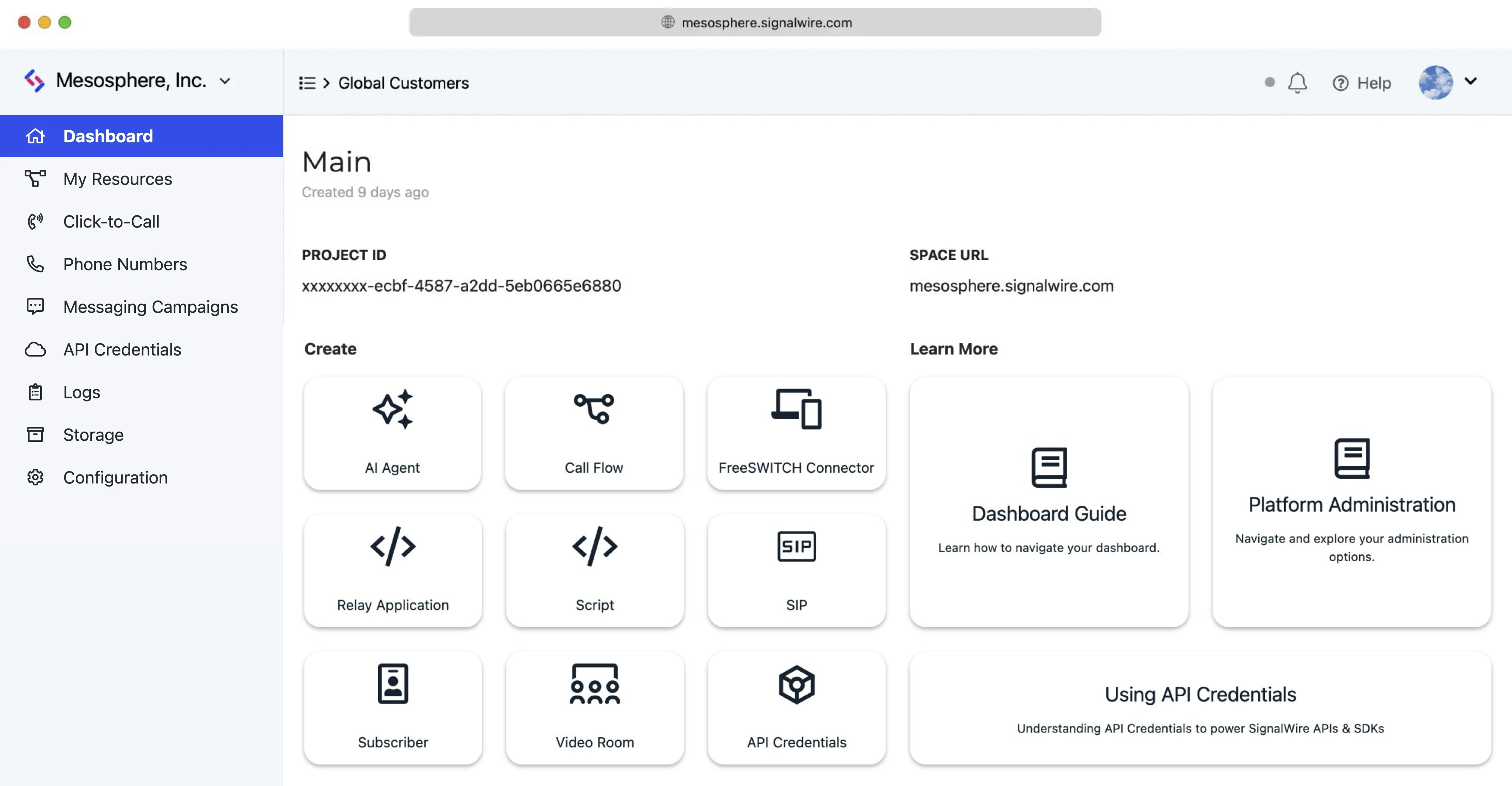
The SignalWire Dashboard
Core concepts
Communication channels
SignalWire supports the following communication channels:
Voice
Phone calls, IVRs, recording, conferencing
Video
Video rooms, screen sharing, recordings
Messaging
SMS and MMS text messages
Chat
Real-time chat for web and mobile apps
AI
Intelligent voice agents powered by LLMs
Fax
Send and receive faxes programmatically
Most channels can work over different transports depending on how you want to connect:
| Transport | What it is | Common uses |
|---|---|---|
| PSTN | The traditional phone network | Calling regular phone numbers, receiving calls from landlines and cell phones |
| SIP | Voice over IP protocol | Connecting PBX systems, desk phones, softphones, and VoIP carriers |
| WebRTC | Browser-based real-time communication | In-app calling, video conferencing, browser-based contact centers |
For example, a voice call could come in via PSTN (someone dialing your number), SIP (from a desk phone), or WebRTC (from your web app). SignalWire will handle all three.
Phone numbers
To make or receive calls and messages through the phone network, you'll need SignalWire phone numbers. You can buy local numbers, toll-free numbers, or short codes directly from your Dashboard or the API.
Each number can be configured to handle incoming calls and messages differently - whether that's forwarding to another number, running a script, connecting to an AI agent, or triggering your own application.
Learn more about Phone Numbers
How to buy, configure, and manage your numbers
We also offer the option of purchasing phone numbers programmatically via our Purchase a Phone Number API Endpoint.
Resources
In SignalWire, a Resource is anything that can handle communications - an AI agent, a script, a SIP connection, or your own application. When a call or message comes in, you tell SignalWire which Resource should handle it.
Common resource types include:
- SWML Scripts - Simple JSON/YAML instructions hosted in your Dashboard
- AI Agents - Conversational AI that handles calls autonomously
- Call Flows - Visual drag-and-drop call routing
- Relay Applications - Your own server applications connected via WebSocket
Learn more about Resources
Understanding the different resource types
Addresses
Every Resource has an Address. This is a unique identifier that lets you target and interact with it. Think of addresses as the phone number for any resource, but broader in scope.
Addresses can be:
- Phone numbers - Traditional numbers like
+14155551234for PSTN calls - SIP addresses - For VoIP connections like
sip:user@domain.com - Aliases - Custom names like
/support-queueor/main-conferencethat are easy to remember
A single Resource can have multiple addresses, and you can change them anytime. For example, you might point both a phone number and a custom alias to the same AI agent.
Learn more about Addresses
How addressing works in SignalWire
Subscribers
Subscribers are end users who authenticate with SignalWire to make and receive calls. If you're building a contact center, business phone system, or video conferencing app for example, your users become Subscribers.
SignalWire manages these users for you. You create, update, and delete them through our REST APIs, and each Subscriber gets:
- Authentication - Secure credentials and tokens for logging in
- A callable address - They can be reached directly at
/private/username - Multi-device support - They can answer calls from a browser, mobile app, or desk phone
This means you don't have to build user management, authentication, or device registration yourself - SignalWire handles it.
Learn more about Subscribers
User management and authentication
Start building
Now that you understand the basics, let's figure out the best way for you to build. The right approach depends on what you're creating and how you prefer to work.
What are you trying to build?
You want to build an AI-powered voice agent that handles phone calls.
This is common for:
- Automated customer service
- Appointment scheduling and reminders
- FAQ bots and information lines
- Lead qualification and surveys
- Virtual receptionists
Agents SDK - A Python framework for building sophisticated AI voice agents. You get full control over prompts, custom functions (SWAIG) dedicated to AI, customizeable conversation flow, and seamless LLM integration. Best for complex agents that need to perform actions like booking appointments, looking up data, or integrating with your systems.
AI Agent (Dashboard) - Configure an AI agent directly in your Dashboard without writing code. Set up prompts, choose a voice, add functions, and connect it to a phone number. Great for getting started quickly or simpler use cases.
SWML with AI - Add AI capabilities to your SWML scripts using the ai method.
Good when you want AI as part of a larger call flow that includes other logic.
Quick start with Agents SDK:
pip install signalwire-agents
from signalwire_agents import AgentBase

class MyAgent(AgentBase):
    def __init__(self):
        super().__init__(name="Assistant", route="/agent")
        self.prompt_add_section("main", body="You are a helpful assistant for Acme Corp.")

agent = MyAgent()
agent.serve()
Agents SDK Quickstart
Build your first AI voice agent
Next Steps
Once you've chosen your path, here are some resources to help you along the way:
- Discord Community - Join 8,000+ developers. Great for questions and sharing what you're building.
- GitHub - Example code, SDKs, and open source tools.
- API Reference - Detailed documentation for all our APIs.
If you get stuck or have questions, our support team is here to help at support@signalwire.com.
Happy building!